

Runtime management
Startup, compatible plugin updates, readiness and shared runtime inspection.
For adding, enabling, disabling or removing plugins and loading trusted packages, start with Plugin manager and Package manager. This chapter covers runtime states, compatible implementation updates and inspection.
Startup and shutdown states
A runtime's phase tells you whether it is starting, usable or stopping. Its cleanup status tells you whether owned resources have been released. Read both when diagnosing a failure; a failed startup still needs teardown.
From startup to shutdown
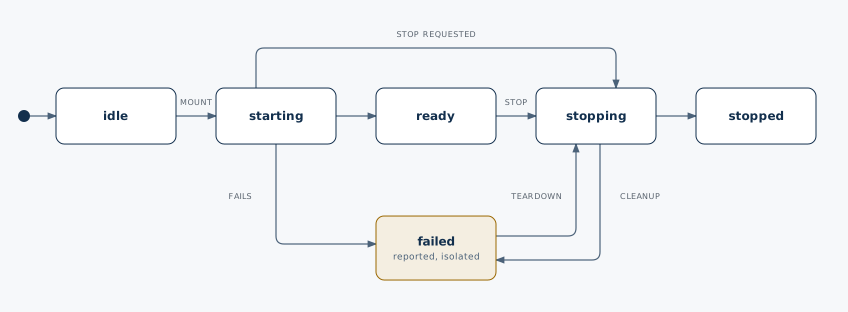
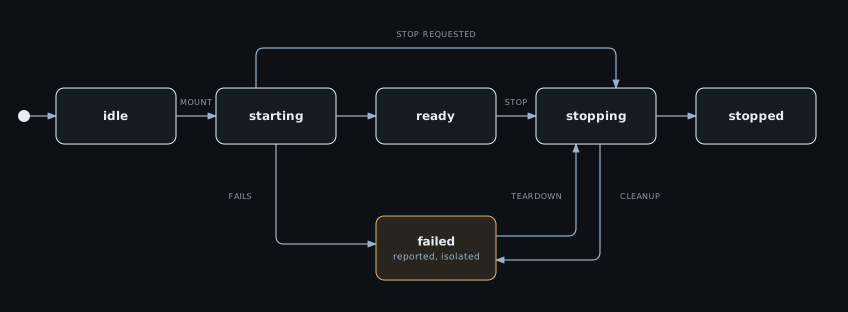
These are common whole-runtime paths, not every per-plugin state. Under isolation,
dependent plugins can be blocked; that does not mean their cleanup failed.
Host-driven plugin updates
runtime.reconcilePlugins(nextPlugins) is an explicit host operation on already loaded,
immutable plugin definitions. Its first consumer is development/manual composition that needs
to preserve unrelated service instances and stores. It is not an automatic discovery/HMR hook.
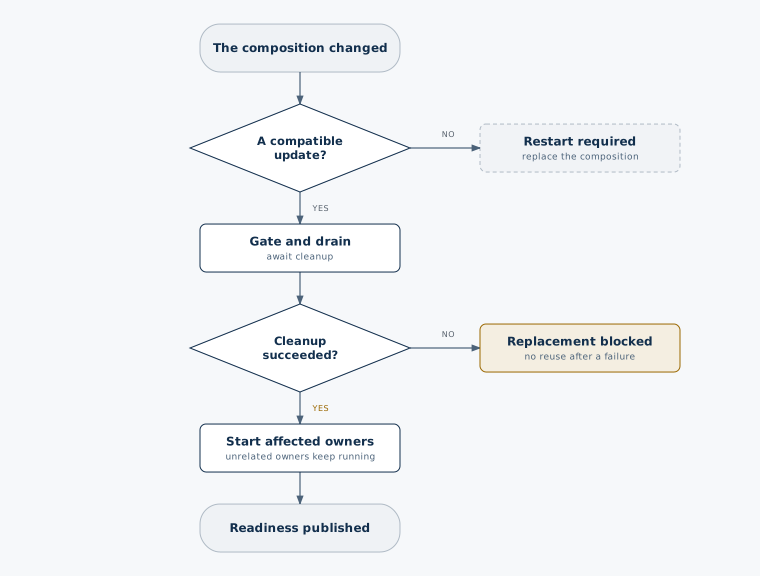
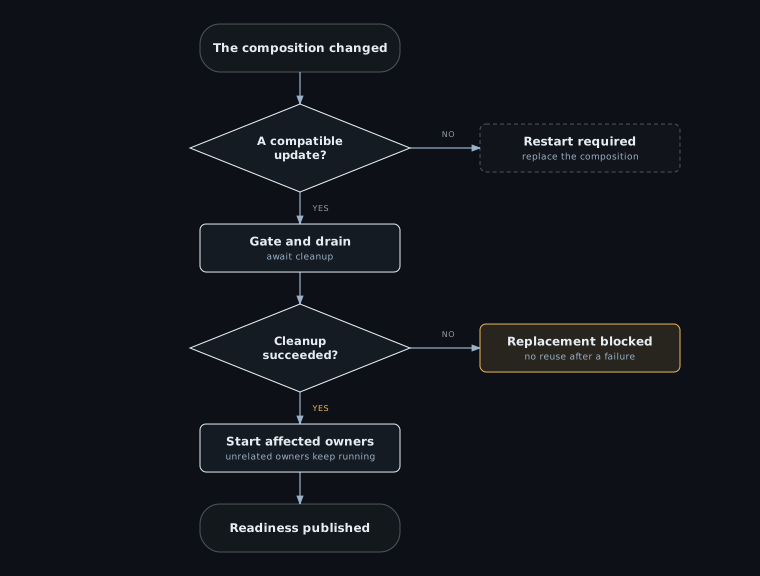
Update compatible plugin owners
// Host code, after initial runtime.ready. Keep unchanged definitions by reference.
const next = (runtime.config.plugins ?? []).map((plugin) =>
  plugin.id === updated.id ? updated : plugin,
);
const result = await runtime.reconcilePlugins(next);
console.log(result.status, result.revision, result.changed, result.affected, result.reasons);| Result | Meaning |
|---|---|
applied | Selected plugins finished starting; unchanged instances survive. No-op retains revision. |
restart-required | Unsupported structural change detected before mutation; host may replace composition. |
blocked | Invalid proposal, overlapping operation, shutdown or earlier failed cleanup. |
failed | A stop/start failed; inspect lifecycle, repair and explicitly retry if cleanup completed. |
Supported updates retain plugin IDs/order, service IDs/aliases/required-service shape and the same settings, events, config and slot declarations. Change implementations, Actions, setup, pages, widgets or metadata by passing a new plugin object; never mutate existing definitions. Definition comparison is referential, not a code hash or deep schema comparison. Reconstructed foundational declarations conservatively require replacement even if structurally similar.
The affected set includes declared plugin dependents, required-service consumers and scopes
that read composition with scopeModules/scopePlugins. Dependents stop before providers;
selected services start serially in dependency order. Owned Actions are cancelled and drained,
scopes revoke contributions immediately, then cleanup is awaited. Unrelated services stay alive.
Declare dependencies for captured cross-plugin services; optional reads alone do not create edges.
For reconcilePlugins, membership/order and service contract changes require composition
replacement. Use the plugin manager for supported additions and removals. Replacing the app,
providers, installers/interceptors or auth/i18n/settings-storage providers still requires composition
replacement. Core does not install packages or evaluate arbitrary code.
Child scopes and parallel startup remain deferred until a consumer requires them.
A failed start cleans the partial affected set and permits an explicit new attempt. Failed cleanup blocks further updates and remount; stop still attempts remaining cleanup and rejects. Recovery does not roll back external effects or resurrect old state. Revision increments when the new definitions are committed, even if their subsequent startup fails; check the result and lifecycle, not revision alone. Initial readiness remains true during a compatible update, including a failed update of another owner. Unaffected pages and widgets stay mounted, keeping their drafts and focus. Affected pages/widgets can remount and lose their own local drafts.
Readiness during updates
Most UI uses PluginPage, PluginSlot and the service hooks, which handle owner readiness.
A custom host can check one plugin explicitly:
const available = useBitaKitReady('reports');
return available ? <Reports /> : <p>Reports are unavailable.</p>;
Import useBitaKitReady from @bitakit/ui. Without an argument it reports initial startup
readiness, not the success of every later update. It becomes false on full shutdown.
| API | What it reports |
|---|---|
runtime.isReady(pluginId) | Whether this plugin is currently ready after initial startup |
runtime.isServiceReady(name) / app.has(name) | Service and owner readiness, including aliases |
useService(name) / useServiceState(name, selector, fallback) | Current ready instance/state; fallback while that owner is unavailable |
useSlot(name).phase | Declared slot owner's phase; absent for legacy undeclared outlets |
<PluginPage unavailable={...} /> | Host fallback for an unavailable matched page owner |
Plugin pages are client components. During server rendering and while their plugin starts,
PluginPage renders unavailable (nothing by default). Pass a placeholder so the route keeps its
shape, for example <PluginPage unavailable={<Skeleton className="h-40" />} /> with Skeleton from
@bitakit/ui/components.
A failed/blocked slot owner is not indefinitely pending; read phase for its state.
Payload validation failures still appear as error. Affected dialogs close before replacement;
unrelated dialogs remain. runtime.hasService(name) is raw presence for lifecycle infrastructure,
so a stopping instance can still exist for dependent cleanup.
Ordinary Action bindings also wait for their owner: the adapter hides/disables them before
evaluating dynamic fields that could read a starting service.
Composition readers, including App Preferences projections, remain part of the affected set: their Settings bodies can remount. State retention covers unaffected UI, not changed component types, affected projections, removed owners or a whole-runtime replacement.
Invoke and await updates from host management code, never from an affected Action, setup/start
hook or disposer: otherwise the operation can wait for its own caller. runtime.ready remains
the initial-mount promise; await the update result for later readiness. React provider config
changes still replace the whole runtime. File-based Next refresh has separate full-reload and
stale-import limitations; these APIs do not claim state-preserving file HMR.
Add, disable and remove trusted plugins
The Plugin manager guide covers runtime.plugins.add,
disable, enable and remove, with dependency policies, cleanup and recovery. These structural
operations are separate from compatible implementation updates through reconcilePlugins.
Preview and host-owned Actions
Use runtime.plugins.preview({ operation: 'disable', id: 'notes', dependents: 'stop' })
to inspect the same dependency plan execution uses, without stopping anything. The result
contains status, revision, changed, affected, dependents, typed reason, blockers
and diagnostic reasons. For enable, omit dependents. Supply preserve: ['management']
to prevent disabling an essential owner, including through dependency closure. Pass the
preview's revision as expectedRevision to enable/disable after confirmation; a stale
revision is blocked. A preview grants no authority to execute later without revalidation.
runtime.bindHostAction(id, defineAction(...)) binds a host-owned Action through the existing
root scope and adapter after readiness. Its returned cleanup is idempotent, and full runtime
shutdown also releases it. This permits an Action to await supported plugin changes without
being owned by an affected plugin. Its service requirements participate in update planning.
Never call it from plugin code or await the enclosing runtime's full stop from that Action.
React's runtime provider supplies one internal pluginManagementAction for enable/disable.
Use normal Action bindings with { id, operation, expectedRevision, preserve };
the standard confirmation lists affected plugins and the Action reports pending/failure.
It owns no additional runtime or persistence. Session changes do not alter host configuration.
A build-included package catalog
The Package manager guide shows how to generate a
trusted lazy catalog and activate it through @bitakit/packages, including selection, scope
changes and current limits.
Shared inspection schema
import { inspectRuntime, observeRuntimeInventory } from '@bitakit/core';

const snapshot = inspectRuntime(runtime);
// { version: 1, static: { plugins: [...] }, live: { revision, phase, plugins, services, actions, slots } }
const reader = observeRuntimeInventory(runtime);
const unsubscribe = reader.subscribe(() => console.log(reader.get()));
// Release the observer when the host view closes.
unsubscribe();import { useRuntimeInventory } from '@bitakit/ui';
function Status() {
const inventory = useRuntimeInventory();
return <output>{inventory.live?.phase}</output>;
}| Field | Evidence and limits |
|---|---|
static.plugins | IDs, configured enablement, public metadata, dependency names and declarations. |
source / declaration source | File/package/runtime attribution; null when unavailable. |
Declaration resolution | file is static file evidence; resolved is a known declaration ID. |
live | Runtime phase/revision, plugin/service phases, public Action flags and slot counts; CLI uses null. |
| Missing package plugin ID/declarations | null, never guessed by executing installed plugins. |
bitakit info and info --json, Devtools and the App Preferences plugin overview use this
version-1 vocabulary. CLI inventory is static and retains disabled local plugins. Runtime
inventory describes the current composed runtime; plugins filtered out by controller isolation
are reported in controller diagnostics, not invented as runtime instances. It is not a merged
remote management catalog. The JSON shape replaces the older raw discovery output.
Inspection omits config/settings values and defaults, service/store contents, Action
inputs/results/errors, callbacks, icons and component payloads. Public metadata and source paths
are intentionally visible, so do not put secrets in them. createInventory builds the shared
DTO envelope; it does not scrub arbitrary data supplied by a caller. Interactive Devtools
execution, event recording and service inspection still use their existing APIs and may expose
application values. Snapshot identity is retained while its source snapshots are unchanged.